
EduXal · For Schools
Helping Every Student
Reach Their Potential
The Pattern You Already Know
Most students aren't failing because they are unmotivated. They fail because of a silent, compounding pattern: they drift during class, promise themselves they will "catch up later," and when exams arrive, they get overwhelmed. To cope, they revise the topics they already understand—reinforcing their strengths while quietly avoiding their actual weaknesses.
This isn't unique laziness. Eight out of ten of your students are living this exact pattern right now. It is not a teacher problem, nor a student problem. It is a structural consequence problem, and it has a straightforward fix.
8 in 10 students in your school are living this pattern right now.
This is not a motivation problem. It is a consequence problem — and it has a structural fix.
The Root Cause
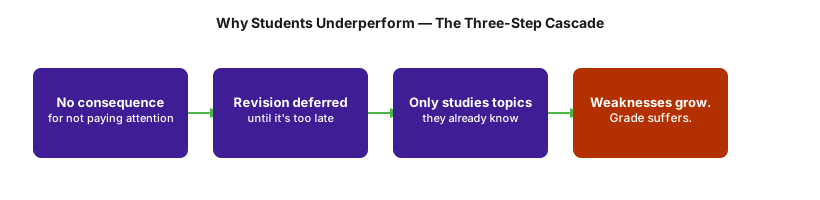
The difference between an adult who acts and a student who procrastinates is not character—it is consequences. Adults act because consequences are immediate and severe: unpaid bills, missed deadlines, job risks.
Students face no immediate consequence for zoning out today. The exam is months away, making the cost of inattention invisible. This lack of immediate feedback creates a chain reaction: students defer learning, get overwhelmed at exam time, and default to studying what they already know. The exam inevitably exposes their untouched gaps, and grades suffer.
The Solution Every Teacher Knows — and Why It Doesn't Work
Every experienced educator knows the solution: frequent, low-stakes assessments per topic. Testing students shortly after a topic is taught provides immediate feedback and consequences while there is still time to recover.
But doing this at scale creates two insurmountable bottlenecks for teachers:
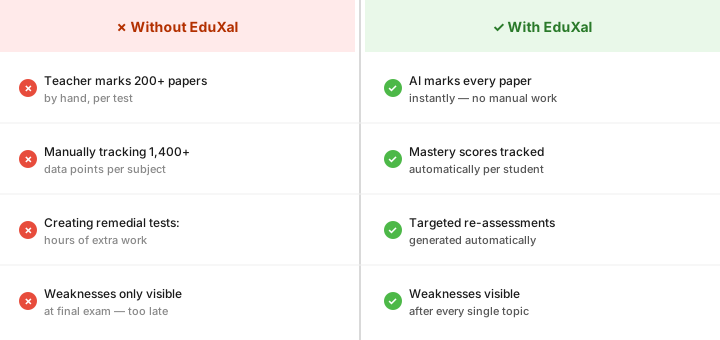
1. Marking Volume: A teacher with 5 classes of 40 students has 200 papers to mark per test. Across 7 topics, that's 1,400 papers. It turns teaching into a full-time administrative job.
2. Data Tracking: Organizing 1,400 individual performance data points per term is impossible to maintain mentally or in manual spreadsheets.
The numbers add up fast:
5 classes × 40 students = 200 papers to mark per test
200 students × 7 topics = 1,400 data points to track
Per teacher. Per subject. Every term. On top of teaching.
Teachers aren't failing—they are simply operating without the necessary infrastructure. The system was designed before the tools to support it existed.
What EduXal Does
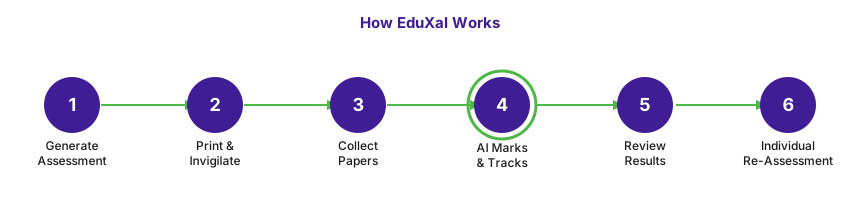
EduXal automates the entire assessment cycle without requiring student devices:
1. **Print & Administer**: Teachers generate topic-specific assessments in seconds, print them, and administer them in class. This ensures invigilated, honest work—not copied homework.
2. **Scan & Mark**: Teachers photograph the completed papers using the EduXal app. **The AI marks them instantly**, recording granular, topic-by-topic scores.
3. **Targeted Remediation**: For students who miss mastery, the system automatically generates **unique remedial questions** tailored specifically to their previous failure patterns.
Students don't hate exams—they hate failing. A massive end-of-term exam makes failure feel inevitable and humiliating. But a short, single-topic assessment is a manageable, focused challenge. It gives struggling students a real chance to succeed and build confidence.
Students don't hate exams. They hate failing.
A short, single-topic test gives even a weak student a real chance to be the best in class on one thing. That changes everything.
What This Means for Your School
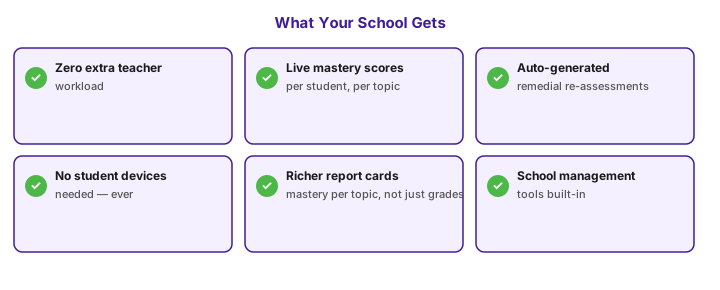
First, your teachers' workload decreases. Generating, marking, and tracking assessments are handled automatically, freeing teachers to focus entirely on targeted teaching.
Second, you gain **unprecedented visibility into student progress**. Instead of vague end-of-term averages, you get a live mastery score per student, per topic. This transforms parent-teacher meetings: instead of telling a parent their child has a C+ in Math, you can show them exactly which three topics need attention before the next exam.
Third, **remediation is automated**. When a student struggles, EduXal generates their personalized re-assessment without the teacher having to design it by hand.
No new devices required. EduXal runs entirely on paper the school already has. One device for the teacher. Nothing for students — no phones, no tablets, no computers. Ever.
EduXal doesn't promise a magic shortcut. **Students improve because teachers act on precise data, and students are re-tested on their exact weaknesses until they are closed.**
The Bigger Picture
Schools that implement consistent, frequent assessments and track mastery systematically will consistently outperform those that do not. This academic advantage compounds over time.
EduXal's long-term vision is to build an educational operating system for the African continent—partnering with governments, integrating with national curricula, and building comprehensive question banks. The schools that join our pilot program now are leading a shift that is coming either way.
How to Get Started
Getting started takes one message. Here is how it works:
- 1
Reach out via eduxal.com. The website connects you directly to a WhatsApp conversation with the EduXal team. Tell us about your school and we will take it from there.
- 2
We set up your school. EduXal creates your school's account and gets your administrators and teachers onboarded. You do not configure anything from scratch.
- 3
Download the app and go. EduXal is available on both mobile and desktop — for teachers and administrators. Generate your first assessment, print, invigilate, scan, and see results. That is the full loop.
You will have run your first complete assessment cycle within the first week.
Why Join as a Pilot School
EduXal is actively onboarding its first schools now. This is not a finished product being handed over — it is a partnership being built. Schools that join at this stage get something no later school will:
A direct line to the team. Not a support ticket. Not a chatbot. A real conversation with the people building EduXal. If something is not working for your school, you tell us directly and we fix it.
Your voice shapes the product. Pilot schools can request features. If your teachers need something specific — a report format, an assessment type, a workflow — raise it with us. Features built for pilot schools ship for everyone.
First access to everything new. Every improvement, every new capability, every upgrade — pilot schools get it first. You will always be ahead of schools that join later.
Ready to get started?
Visit eduxal.com and send us a message. We will get back to you the same day.
Closing
The education system has operated under the same structural ceiling for fifty years. The tools now exist to do what was previously impossible: to give every student an individually tracked, personalized learning journey—at scale, without crushing the teachers who make it happen.
"Why should the education system remain limited by a ceiling we couldn't breach 50 years ago? The world is evolving. Education must evolve with it."
Ready to bring EduXal to your school?
Pilot spots for 2026 are limited. Get in touch today.
Schedule a Demo on WhatsApp